Bad habits in the Benelux – the wayward learning of Andy Schleck

Andy Schleck has probably forgotten more about bike riding than most of us will ever learn. but the one thing he is yet to learn is perhaps the lesson he most needs: Success begets success.
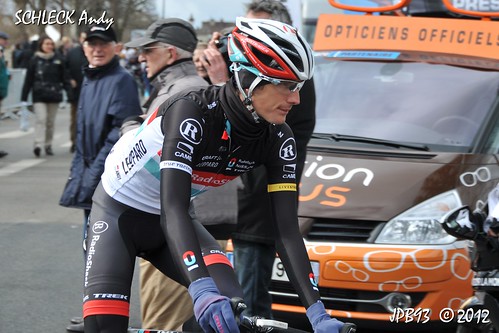
PARIS-NICE 2012 - SCHLECK Andy

Image by Jean Pierre Belot on Flickr

(Having typed that, I’m suddenly doubtful. Most of us can: get down a hill without soiling our nappy; change gear without coming to a grinding halt; work out that a bike on which we can barely reach the drops of the handlebars probably isn’t the right fit; accept that you don’t win by riding for someone else when you should be attacking.)

But here’s a simple test if you think I’m being unfair: Not including the Tour de France 2010, which he won by default, can you name the last multi-stage race in which Andy Schleck won the overall classification. And for a bonus point what was the last race which Andy Schleck won. * (what I think are the answers at the bottom of this post)

The more consistent I become in gaining world-class results the less doubt there is in my mind.  – Bradley Wiggins, on winning Paris-Nice

There’s plenty of knockers for Wiggo – some of them with so little point to what they’re saying you could barely push your way through the skin on a custard with them – but one thing you can’t knock him for is understanding that if you want to win big you have to start winning often.

Look at Alberto Contador and Cadel Evans: when they turn up to race, they don’t turn up just to get round or maybe test their legs on one climb on one stage. They turn up and give the tree a shake because they know that the confidence you gain from a good result is worth far more than another winter spent in the wind tunnel trying to make yourself less like a square rigged sail on a time trial bike.

In consecutive years, on the final climb of the Tour de France, Andy Schleck has turned to them and begged like a child for them to help him or to attack. They in turn have looked back at him with eyes full of the knowledge and confidence that they’ve learned how good a win feels and quite like where they are sitting in his wheel.

Andy seems content to carry on giving isolated stages a bang in the Tours of Switzerland and California while ignoring opportunities to ride the exact route of the decisive stage of the Tour de France in race conditions.

As I look at today’s results, Andy Schleck finished 2 minutes back on stage two of the Volta a Catalunya, back with the crash victims and domestiques. Up in the front group: Wiggins, Gesink, Van den Broeck, Leipheimer.  Now that could be simple bad luck, but then again misfortune has a habit of finding easy victims.

His opponents see every race as a chance to start building the trust in colleagues and establish when they need to rely on themselves; to figure out the logistics and interlinking skills needed in a three-week race; to find their voice as a leader and how to motivate their team.

Every race is about practicing good habits, building momentum, learning how to improve your weaker areas and figuring out your rivals. Andy seems to view them as a minor inconvenience to be endured until July and the Tour de France comes round.

Cyrille Guimard who shaped him at VC Roubaix compared his talent to some of his previous charges such as Greg Lemond, Bernard Hinault and the late and much missed Laurent Fignon.

Andy Schleck is 26, an age at which Fignon had two Tours de France to his name and, but for an errant helicopter,  should have also had a Giro d’Italia. It’s all very well point to his young rider’s classification jerseys, but as the leading rider of his age by a margin, they aren’t really enough of a return on his talent. Raymond Poulidor may have become mythologised as the eternal second, but he won plenty in his time. Andy Schleck hasn’t won a great deal.

Finally, let’s talk about the Galibier stage of the Tour de France 2011. It’s easy to focus on the attack on the Col d’Izoard and the 2’15” between him and Cadel Evans at the finish. But take a look at that final kilometre to the finish: Evans took 45 seconds back on Schleck. At 5km to go, the gap was 3’15”, at 11km it was 4’15” according to the Cyclingnews account of the stage.

Those 45 seconds made a world of difference the next day when Evans sat tight less than a minute behind Schleck, and the day after that, when he started the time trial with one minute to take back on a course he knew rather than the thick end of two.

* By my reckoning, the last time Andy Schleck won a stage race was the Fleche du Sud in 2004 as an 18-year-old amateur. The last professional race in which he finished first was Liege-Bastogne-Liege in 2009.
Posted in Andy Schleck, Professional | Tagged , , , , , , , , , | Leave a comment

Hi-Viz yellow, a blot and a blight on the landscape

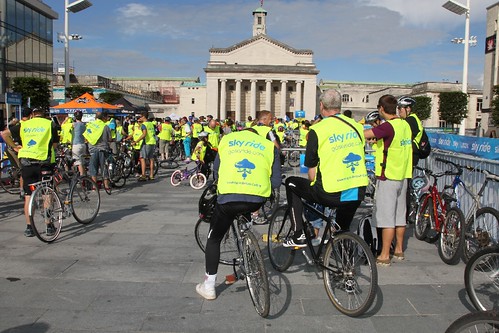
Sky Ride Southampton_11-08-14_054

(Just imagine how much nicer the picture above would be if the bottom half weren’t obliterated by eye-gouging yellow)

Hi-Viz yellow is a blot and a blight on the British landscape. Like the increasingly common “daylight” LED headlights, it is a solution that creates as many problems as it solves.

The ubiquity of the heavy yellow fabric, inevitably stained with grime up the back, disheartens me on a daily basis. It’s lazy, ugly and  depressing, the antithesis of everything riding a bike should be.

I was once told a story of a watercolour painter who found that he found it increasingly hard to paint the glorious landscapes of Dartmoor on account of the eye-bleeding distraction of luminous yellow trooping across the Tors. Looking at the picture at the top of this post, I know how that painter feels.

I’m not totally opposed to bright colours. I wear a very bright pink Rapha gilet on occasion and at the right time of day or night, I’m a big fan of reflective materials to catch the eye of other road users. I’m a fan of eye-catching colours when the light is flat or there’s mist or fog – like this morning when I wore my Liquigas lime green gilet – which reduce visibility, but there are many more colours than simply yellow.

Hi-Viz yellow is symptomatic of a passive state in which that the wearer has been made safer simply by putting on the garment, rather than actively seeking to be safer by using lights, observation and other elements of roadcraft. That’s all before it’s often hidden behind a bag or rucksack.

Under sodium orange glare of street lighting I find that it tends to bleed into the background, rendering it no safer than anything other colour. Only things like the reflective panelling on Respro’s hump  really stand out in those conditions.

More than anything it seems to be a peculiarly Anglo-Saxon obsession. I don’t think I’ve ever seen it making the same visual dent in the landscape of France, Italy, the Netherlands or Denmark, or the usually cautious Germany.

On clear day there is no justification for claiming that a cyclist is any harder to spot than a pedestrian crossing a road. No one has ever suggested in all seriousness that pedestrians should all wear yellow tabards for crossing the road as a matter of course.

But a significant proportion of British cyclists default to yellow rather than exploring the spectrum of opportunity, from the brightest of peacock blues to bold purples and glorious reds. Go out my readers and ride away from the boring, dare to push away from lazy choices.

Cycling should be about moving as part of your landscape, the sensation of oneness with the terrain around you, not gouging a visual tear in the landscape.

If tomorrow you burn your hi-Viz jacket or bib, then you will have done something to restore a little bit of beauty to the experience of cycling.

Posted in Clothing | Tagged , , | 1 Comment

What we learned from the London Track World Cup

Who better to show you around the new London Velodrome than cycling addict Sir Paul Smith?

  • Percy Pigs are the food of champions

Lizzie Armitstead ate no less that five of them, doesn’t seem to do her any harm. I ate three bags and don’t seem to have suffered either.

  • If you put in a curved, panelled wood roof on a wooden track, it makes for really good reverb and amplification

The noise was deafening whenever a GB rider was on the track. Not just loud in volume, but that roaring noise that hits you physically. Even when it was only about a quarter full as everyone streamed out on Sunday night, the applause during the medal ceremonies was still loud.

  • Sir Chris Hoy is an Olympian like no other

Whether it’s hitting 78.4km/h in the Keirin to ride round three riders inside him, or leading by example, he is a Colossus of a man. Physically he may not bulge like the German sprinters but for sheer presence he outmuscles everyone.

  • When the shut the doors, the heat is unbearable

It’s meant to sit at around 28 degrees Celsius, but apparently can hit 31-32. You don’t need a jumper to sit in the stands. I was almost giddy with the heat at times. Well, that and the massive buzz of excitement.

  • If the Omnium finished with a bunch race it would be completely compelling

Watch Laura Trott defying the odds on Saturday night and then think how cool it would be if the event climaxed with what is essentially last man standing.

  • GB’s man one crisis in the team sprint is simple: stick Jason Kenny at one

Jamie Staff clearly thinks Kenny is quickest, the mutterings are that he can go faster than Edgar at man one. In qualifying, there was about 0.3 seconds across the top four. If Kenny at one closes that gap, GB are back on Gold standard at two and three.

  • Someone needs to have a word with whoever is running the PA system

Too much compression means everything comes out loud, so the music bleeds into the commentary and nobody can hear either properly. Reduce the compression, bring back in a bit of dynamic range and there will be natural separation of the two.

It’s a “wet” room naturally so there’s very little need for so much sloppy reverb like you would need in another venue.

Posted in Track | Tagged , , , , , , , , , | 1 Comment