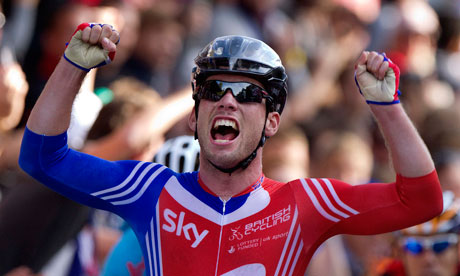
Analysis: How Great Britain won the world championship for Mark Cavendish

Mark Cavendish celebrates as he crosses the finish line at the UCI Road World Championships in Denmark. Photograph: Thomas Sjoerup/AP

Mark Cavendish celebrates as he crosses the finish line at the UCI Road World Championships in Denmark. Photograph: Thomas Sjoerup/AP

What more is there to add? There have been few more impressive displays of teamwork in the history of the Worlds.

Lionel Birnie wrote about Project Rainbow, Rod Ellingworth’s plan, in 2008, when pretty much everyone in the world thought Great Britain would never really challenge the big nations on the road. Well on Sunday, they didn’t so much challenge them as stuck their collective dick in the mashed potato of the received wisdom of how to win the worlds.

The Inner Ring has a very good overview of how things went from that plan to the execution.

Richard Williams in The Guardian picks over some important, but easy to miss, application of marginal gains: Skinsuits to save watts (even Jez Hunt was persuaded), time check boards in three places on course, Cavendish’s unvented helmet.

A few more things which I think contributed:

  • Nobody wasted energy going back to cars for instructions as far as I could tell
  • Every lap at least two riders were taking bottles/musettes at the feed, most likely to distribute among the rest
  • Riding in the front 30 throughout meant not losing riders in the inevitable peloton-splitting crash

And before it gets too long in the tooth here’s some other thoughts.

Climbers and GC contenders don’t have to be useless in races that don’t suit them

Spain did it in Beijing in 2008 when both Contador and Sastre sacrificed themselves early on to set up Sammy Sanchez for the gold medal.

Great Britain used Chris Froome, 2nd at Vuelta in similar way to contain early break and fillet down the pack. Then they finished the job by using Bradley Wiggins’ awesome power to contain the attacks in the last lap. His 15km at 55kmh effort made it impossible for anyone to launch a meaningful attack.

Great Britain rode as a team for the team

On that course, it was going to be hard to stay away. Of the threats, only Thomas Voeckler made anything of a strike and even then it was too late without the calibre of rider to make it stick.

The traditional wisdom is to put men in breaks and trying to control it from there. Some people think GB would have done better follow that. Too many variables and without radios, why would you.

The huge engine of Wiggins: 15km at 55 kmh lined it out, how could anyone attack from behind that?

Captaincy on the road will count when race radio goes. David Millar was superb in judging the team effort and keeping the plan on target.

Mark Cavendish may be Britain’s first Mens’s Road Race World Championship winner since Tom Simpson in 1965, but only Nicole Cooke has won National, World and Olympic Road Race titles in the same year.

Posted in Professional | Tagged , , , , , , , , , , , , , | Leave a comment

Ways to celebrate the Leopard Trek-Radioshack Merger

I started with this on twitter last night, got a few retweets, so I thought I’d pull them all together into one blog post and add a few more.

I’ll leave it up to devine which factual events I’m referring to. And yes, these all relate to things that have occurred or been done by staff or riders on both teams.

  • Pay a gynaecologist you don’t know lots of money for training advice.
  • Unfairly dismiss someone for specious + unproven wrongdoing. Do it twice if you can.
  • Cane that beetroot juice. You’ll make it to office first everytime! (from Brassyn)
  •  Deny any connection with the man you just bought dinner for.
  • Repeated cheat in your job then act like nothing happened when applying for a management role.
  • Use a tape recording to answer any questions you are likely to be asked today.
  • Acquire a stake in a business then pretend you can’t remember when you got it or how much it is.
  • Quietly erase serious professional wrongdoing from your record and hope no one ever picks up on it.
  • Spend the day looking over your shoulder at your colleagues.

You can add your own in the comments. Only rule: must relate to actual events that have been reported and have a record in fact.

Posted in Funny, Professional | Tagged , , | Leave a comment

Is cycling really worth that much to the UK?

This week nearly every cycling publication, and most of the mainstream press to boot, reported that cycling is worth nearly £3 billion to the UK economy and growing.

The ever-eloquent Dynamite Files sounded a note of caution that I’ve not seen in many other places:

2 NO CHANGE The London School of Economics
The world of numbers is a confusing one for this humble, word-loving blog. On the one hand, it’s probably a good thing that bike-related sales experienced a 28 per cent increase last year, and that cycling now generally seems to be a “sustainable trend” in Britain. On the other, the report by the LSE which identified this “step-change in the UK’s cycling scene” was commissioned by British Cycling and Team Sky’s paymasters, and it was written by a cyclist from the seemingly unconnected field of “innovation and productivity”. So if someone cleverer than The DYNAMITE! Files could take a look at Dr Alexander Grous’s report and tell us if its findings stand up or if it’s a load of PR flimflammery, we’d be much appreciative. Cheers.”

Well let’s start at the top…

The report is subtitled “Gross Cycling Product”

Now I’m a rubbish economist, but even I know that you should never trust the gross value of anything because it’s the net value that counts. Here’s a rough reckoner of the difference between Gross versus Net.

The first thing that springs to mind that might have a significant impact is currency exchange rates. Pretty much the vast majority of bikes sold come from the Far East, in particular China and Taiwan. Any fluctuation in exchange rate would affect the cost to business and purchaser in the UK.

Let’s take the example of a fairly standard bike, with a frame made in Taiwan and components by Shimano (Japan) and see what we we can find out about the net cost. Let’s call it a classic Cycle to Work scheme 999GBP bike. That price point hasn’t shifted.

I stuck the period August 2009 to August 2011 into OandA.com for a few currencies to see what change had occurred. Here’s the results for various useful currencies in CSV format

In that period, the pound sterling (GBP) has gone from being 157 Japanese Yen (JPY) to in the region of 126 JPY. So in rough terms, you get 20% less JPY, which in turn means that the cost rises by the same for your Shimano component being bought and put onto the bike you purchase.

On top of that Shimano prices have risen considerably to offset this. For example, this claim on London Fixed Gear (LFGSS) in March 2009 has them putting 30% on list prices. I don’t believe this has been the only rise over that period.

Now look at the Taiwan frame and maybe other parts. The Taiwanese Dollar (TWD) has gone from 54 to 46 over the same period. That’s around 15% drop, again reappearing in the net cost.

So on both those currencies, you’re looking at it costing roughly 17.5% (split the difference) more for the same bike for the retailer without even adding a penny to the price.

That’s before you factor in UK inflation rates which have pretty much doubled in the last couple of years. And stick in the 2.5% increase in VAT at the beginning of 2011 which not only adds to the gross cost but forced a cut in margins.

OK I’m being slightly unfair as apparently this report is into the gross cycling product for 2010. But it’s not unrepresentative of some of the factors that you might like to consider before considering that £3 billion figure again or the claim that

“28 per cent increase in volume of cycle sales in 2010, generating £1.62b”

But enough of fag packet economics, here’s some other things to consider

What is a cyclist?

By far the most difficult thing for me about the report for me is the definition of cyclists. Here’s how the report breaks down the main segments

  1. Occasional Cyclist: Cycles infrequently; less than other categories
  2. Regular Cyclist: Cycles 12 or more times in the past year
  3. Frequent Cyclist: Cycles once per week or more

And here’s how those segments represent the market:

… almost 4.3m (33 per cent) are classed as Regular Cyclists, 5.4m (41 per cent) are classed Occasional Cyclists and 3.5m (26 per cent) are classed as Frequent Cyclist

So to be a Regular cyclist you only have to ride your bike once a month, on average. And to be classed as Frequent you only have to ride your bike once a week. That’s a pretty loose definition of regular for me. It’s regular in the sense of haircuts; tax; payslips and a decent meal out – not in the sense of getting up; nor going to work; nor buying a pint of milk.

By this same criteria I would be classed as a regular car driver for 2011, having hired a car on holiday for a fortnight and made roughly 20 trips during the holiday. I’d also be a regular cyclist, having hired a bike and made a similar number of separate journeys.

Hang on you say, why are you counting separate journeys? Well because these figures tend to count going to the beach and back as two separate “trips”. In fact in one day I made at least 6 “trips” as we hopped along the coast for lunch and a swim.

I could spend hours asking similar questions, I don’t want to waste my day off doing it. So next time you see a report paid for by people who rely on a positive picture for their funding and people who are investing corporate wealth for some form of return: Ask yourself what the story really is.

Posted in Business, Economics | Tagged , , | Leave a comment